

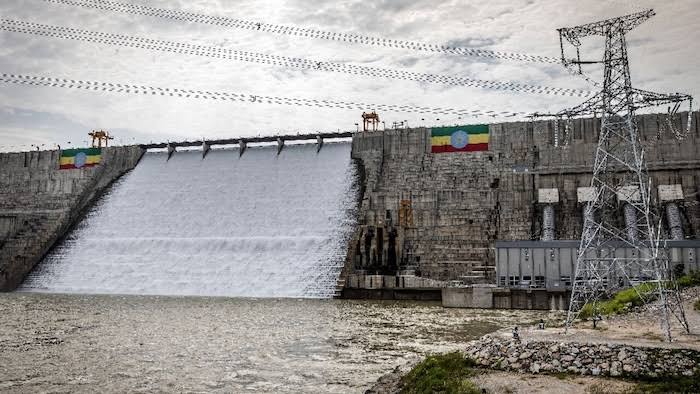
Ethiopia on Tuesday inaugurated the Grand Ethiopian Renaissance Dam (GERD), the continent’s largest hydroelectric project, with Prime Minister Abiy Ahmed hailing it as “a great achievement for all black people” despite years of fierce opposition from downstream neighbour Egypt.
Gatekeepers News reports that the $4-billion megastructure, built by Italian firm Webuild, towers 170 metres high and stretches nearly two kilometres across the Blue Nile near the Sudanese border. Designed to hold 74 billion cubic metres of water, GERD will generate 5,150 megawatts of electricity — more than doubling Ethiopia’s current capacity and making it Africa’s largest dam by power output.
“GERD will be remembered as a great achievement not only for Ethiopia, but for all black people,” Abiy said at the inauguration, attended by regional leaders including Kenyan President William Ruto and Somalia’s President Hassan Sheikh Mohamud.
“I invite all black people to visit the dam. It demonstrates that we, as black people, can achieve anything we plan.”
For Ethiopia, the dam has become a rare unifying national project in a country scarred by civil conflict. But for Egypt, which relies on the Nile for 97 percent of its water, GERD represents what President Abdel Fattah al-Sisi has described as an “existential threat.” Cairo has vowed to use all measures under international law to safeguard its water security.
Abiy sought to calm those fears.
“For downstream countries, Ethiopia has accomplished GERD as a shining example for black people. It will not affect your development at all,” he said.
The celebrations featured a dramatic nighttime display of lanterns, lasers and drones spelling out slogans like “geopolitical rise” and “a leap into the future.”
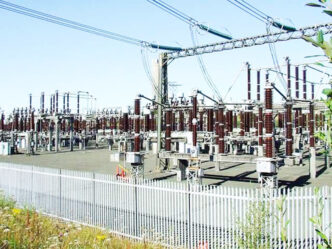
Analysts say the project, under construction since 2011, could transform Ethiopia’s economy by reducing blackouts, powering industries, and exporting electricity through regional interconnectors reaching as far as Tanzania. Nearly half of Ethiopia’s 130 million people currently live without electricity, according to the World Bank.
Webuild’s CEO Pietro Salini described the inauguration as a milestone.
“It is no longer a dream but a fact,” he said. “This country that was dark in the evening when I first arrived here is now selling energy to neighbouring countries.”
Salini dismissed fears in Cairo and Khartoum, arguing that hydropower projects do not consume water.
“The hydroelectric project releases water to produce energy. They are not irrigation schemes that consume water. There’s no change in the flow,” he said.
Despite repeated mediation efforts by the United States, World Bank, Russia, the UAE, and the African Union, no breakthrough has been reached in more than a decade of negotiations. Analysts warn that for Egypt, GERD is as much about politics and security as water supply.
“For the Egyptian leadership, GERD is not just about water, it is about national security,” said Mohamed Mohey el-Deen, a former member of Egypt’s technical team on the dam. “A major drop in water supply threatens Egypt’s internal stability.”
Alex Vines of the European Council on Foreign Relations added that Ethiopia’s government has also leveraged the tensions at home.
“With growing domestic political fragility, the government seeks to use the dam and confrontation with neighbours as a unifying strategy,” he said.