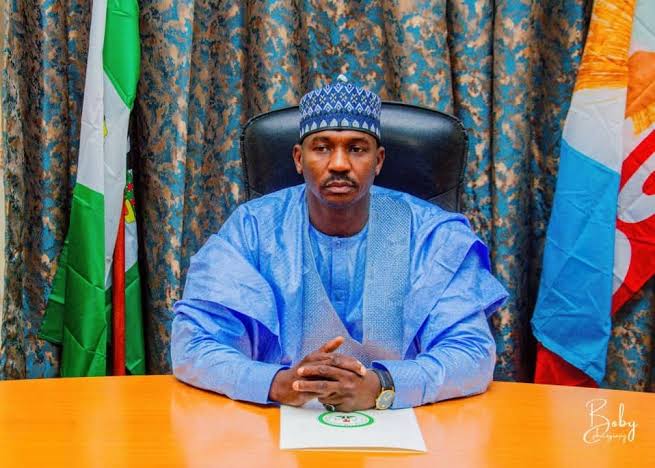
“Progress should not breed complacency.”
Governor Ahmed Aliyu
When Governor Ahmed Aliyu sought the mandate of the good people of Sokoto State, the Seat of the Caliphate, the 9-Point Smart Agenda was for him far more than a campaign manifesto; it was and remains an article of faith between him, the electorate, and indeed every citizen of the state. The Agenda was and remains a clear and deliberate statement of intent, priorities, and values upon which the trust of the people was earned and through which he won the 2023 governorship election. Most often, than not campaign promises are quickly discarded after the elections, but the governor has distinguished himself not just by his fidelity to the contract, but also by anchoring his policies, programmes, and projects firmly on the commitments outlined in the Agenda. More significantly, he has also taken the deliberate step of subjecting the Agenda to a review.
The decision to review the 9- Point Smart Agenda merits attention because, beyond Governor Aliyu demonstrating fidelity to his campaign commitments, he has chosen to interrogate a policy framework that is already producing fantastic results. Especially as the objective of this exercise is the strategic reassessment—one that ensures the 9-Point Smart Agenda remains responsive to emerging socio-economic realities, evolving development challenges, and the changing expectations of the people of Sokoto State it was designed to serve. This is the reflex of a leader acutely aware that successes, if left uninterrogated, can lead to complacency.
At the core of this decision is Governor Aliyu’s governance philosophy, and it is encouraging that the 9-Point Smart Agenda was designed to be dynamic, recognizing that development is seldom linear and that effective governance demands adaptable, evidence-based policies learnt from experience. Reviewing the Agenda reflects an understanding that progress, if left unexamined, can give way to complacency, and that early success does not automatically guarantee long-term impact. The document remains a living document—one that must continue to evolve in response to emerging realities, shifting socio-economic dynamics, and lessons learned from implementation.
Rather than treating initial gains as an endpoint,the Governor Aliyu administration has chosen to regard them as a foundation upon which to build. In many political settings, once results begin to show, the instinct is to declare success, and the temptation is to shout “eureka” and move on. Rather, Governor Aliyu has opted for the more demanding and difficult path—revisiting a functioning policy framework to strengthen its effectiveness, coherence, and sustainability. In the Nigerian context, where flagship policies are rarely reviewed unless they fail, this approach is notable. His choice speaks to both his confidence and the seriousness with which he takes the review.
It is against this backdrop that the governor constituted a high-level Steering Committee to review the 9-Point Smart Agenda. Chaired by the Deputy Governor, Alhaji Idris Mohammed Gobir, the Committee includes the Secretary to the State Government, the Chief of Staff to the Governor, the Head of Service, relevant commissioners, the Accountant-General, senior planning officials, and technocrats from both the public and private sectors. The composition of the Committee reflects an attempt to balance political authority, administrative experience, and seasoned technocrats from the public and private sectors.
The mandate of the Gobir Committee is unambiguous. It is tasked with critically assessing the conceptual foundations of the Agenda, evaluating implementation strategies and performance outcomes, examining alignment with current development priorities, identifying gaps and constraints, and recommending actionable reforms, benchmarks, and monitoring mechanisms. The goal is to strengthen coherence, improve effectiveness, and enhance the Agenda’s long-term impact.
This deliberate pause for reflection has practical implications. The 9-Point Smart Agenda has already brought greater clarity to governance in Sokoto State. It has guided budgeting processes, aligned ministries, departments, and agencies around shared objectives, and reduced the prevalence of ad hoc decision-making. Planning has become more coordinated, and public spending is increasingly being linked to strategic priorities. Yet, the administration continues to treat these gains as work in progress rather than as the final destination.
Deputy Governor Gobir captured this ethos succinctly when he reaffirmed the 9-Point Smart Agenda as the compass guiding the actions of the Governor Aliyu’s administration. His remarks underscored not just its relevance, but its adaptability. The pragmatic objective is to ensure the 9-Point Smart Agenda continues to respond robustly and meaningfully to the evolving needs of the people, emerging socio-economic realities, and lessons learned from its implementation over the last two and a half years.
In the Nigerian context, this approach stands out. Flagship policies are rarely reviewed. More often, they are defended reflexively, quietly abandoned, or overtaken by shifting political interests. Sokoto State’s experience challenges this norm and offers an alternative grounded in reflection rather than defensiveness.
As Dr. Abubakar Muhammad Zayyana, the State Commissioner for Budget and Economic Planning, aptly observed, a sound and effective policy does not emerge by accident; it is the outcome of deliberate thought, technical rigor, evidence-based analysis, and the pooling of collective experience. Subjecting such a policy to periodic review is therefore a demonstration of responsible governance, institutional maturity, and a commitment to achieving optimal and sustainable outcomes.
The prominent role of the Ministry of Budget and Economic Planning reinforces this intent. By embedding the review within fiscal and planning processes, the government is ensuring that recommendations translate into action. Budgets reflect priorities, and priorities shape outcomes. In that sense, interrogating the 9- Point Smart Agenda has direct implications for how resources are deployed and how success is measured.
The overarching objective of this interrogation is to ensure durable impact. The 9-Point Smart Agenda was designed as a framework capable of adaptation, with the objective of improving the quality of life of the good people of Sokoto State. Clearly, clearer mandates for ministries, departments, and agencies have improved coordination, while stronger links between planning and budgeting have enhanced accountability and predictability in public finance.
Equally significant about the review is the emphasis on collective ownership. The involvement of the Secretary to the State Government, the Chief of Staff, Permanent Secretaries, and senior officials reinforces the idea that development outcomes depend on institutional commitment. The inclusion of technocrats, including professionals from outside government, reflects recognition of the value of independent expertise and objective analysis in policy review. Their participation is expected to enrich the quality of recommendations and reinforces the Agenda as a shared commitment.
In a broader sense, the interrogation of the 9-Point Smart Agenda represents a quiet but meaningful departure from Nigeria’s dominant political tradition. It demonstrates that elected officials can review their own work honestly, even when it is delivering results. Yet, the governor still regards these gains as work in progress. It shows that Governor Aliyu is confident enough to ask very hard questions without fear that political opponents can equate the review with failure.
Ultimately, Governor Ahmed Aliyu’s intention appears focused on institutionalizing development. Political tenures are finite, but policy frameworks can endure. By refining the Agenda, the administration is laying the groundwork for continuity and sustained progress beyond the lifespan of the Governor Ahmed Aliyu administration.
The 9-Point Smart Agenda of Governor Aliyu is delivering results. That much is evident. However, the decision to interrogate it reflects a broader understanding that development is not simply about doing things right, but about continually seeking ways to do them better. In a political climate often defined by short-term thinking and defensive policymaking, this approach offers a reminder that governance, at its best, is an ongoing process of learning, adaptation, and improvement.
Governor Aliyu’s oft-stated belief that “progress should not breed complacency” explains the review of what is functional.
Gatekeepers News is not liable for opinions expressed in this article; they’re strictly the writer’s