

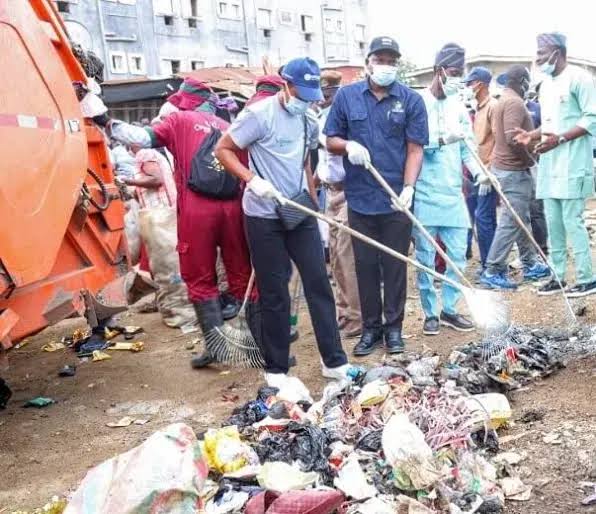
The return of monthly environmental sanitation in Lagos after nearly a decade has drawn mixed reactions from residents, with many praising the initiative while others raised concerns over alleged extortion, movement restrictions and waste evacuation challenges.
Gatekeepers News reports that the sanitation exercise, held Saturday between 6:30 a.m. and 8:30 a.m. across parts of the state, marked the revival of a programme suspended for almost 10 years.
While many residents welcomed the exercise as a step towards restoring environmental cleanliness, others criticised its implementation, especially reports of harassment by officials and street touts.
Some residents said the timing of the exercise allowed them to clean up and still continue with their day’s activities. Yemisi Ogunsan described the schedule as convenient, while trader Biriki Sanni complained that transportation difficulties after the exercise disrupted business activities.
Concerns also emerged over movement restrictions despite assurances by Governor Babajide Sanwo-Olu and the Commissioner for Environment and Water Resources, Tokunbo Wahab, that movement would not be forcefully restricted.
Reports of arrests and alleged extortion surfaced in areas including Mushin, Agege, Oshodi, Coker and Surulere.
One resident told The Guardian he was arrested while heading to his business in Surulere and was only released after paying money.
Residents also criticised the failure to promptly evacuate waste gathered during the exercise, with rain reportedly washing some refuse back into drains.
A Lagos resident, Tomiwa Tegbe, criticised the situation on X, writing: “The waste collected from mandatory environmental sanitation yesterday (Saturday) and dumped on the road waiting for LAWMA to come pick up has been scattered by rain overnight and washed right back onto the road and into the gutters. Look at that, efficiency.”
Another resident, Odufoye Adebayo, questioned the government’s preparedness, saying, “They don’t have the logistics to carry it out on larger scale.”
Some residents called for improved waste management logistics, with suggestions that sanitation could be organised by focusing on one local government area each week.
Responding to the criticism, Wahab said intervention trucks from the Lagos State Waste Management Authority (LAWMA), alongside compactors from local councils, were already evacuating waste generated during the exercise.
“I am pleased to confirm that they are actively collecting and evacuating every bag, every pile, and every debris generated during the monthly environmental sanitation exercise,” he said.
“I assure every Lagosian that we will not rest until the entire city is clean, cleared, and safe. This is the operational backbone of our commitment to a cleaner Lagos and a greater Lagos.”
Despite the challenges, top government officials, including the wife of the governor, Ibijoke Sanwo-Olu, and Wahab monitored the exercise and commended residents for their participation.
After inspecting activities at Ikoyi-Obalende LCDA, Mrs Sanwo-Olu described the turnout as encouraging.
“I think the assessment for this morning is good. It was flagged off last month, and we’re having the first incident today. We have seen the residents come out. We have seen them participate. It’s like a gradual process,” she said, urging residents to make sanitation a regular habit beyond the monthly exercise.
Wahab also praised community participation, saying compliance was impressive.
“It’s mind-blowing. It’s over 98 per cent… Most importantly, let us build on this… someday, somehow, that culture will be back. And to the naysayers, they can see it themselves,” he said.
On the controversy over movement restriction, Wahab referenced Court of Appeal decisions, insisting the state retains powers to impose restrictions, though government chose not to enforce that route.
However, Senior Advocate of Nigeria, Ebun-Olu Adegboruwa, faulted the exercise, arguing Lagosians were unlawfully compelled to remain indoors under the guise of sanitation.
He accused the government of using agencies and touts to harass residents and challenged the state to publish any law authorising movement restrictions.
“For the avoidance of doubt, there is currently no law in force in Lagos State that permits the government to restrict movement for the purpose of enforcing monthly environmental sanitation,” he said.
Adegboruwa further described the practice as outdated, arguing modern sanitation should rely on effective policies rather than what he called “dictatorial policies of the inglorious military era.”