

Global oil prices extended their decline on Thursday after United States President Donald Trump and Iranian President Masoud Pezeshkian signed a deal aimed at ending hostilities between the two countries and reopening the strategic Strait of Hormuz.
Gatekeepers News reports that the agreement raised hopes of a lasting peace after more than three months of conflict that disrupted energy markets and heightened inflation concerns worldwide.
However, investor optimism was tempered by expectations that the US Federal Reserve could raise interest rates later this year after its new chairman signalled continued concern over inflation.
Trump signed the memorandum of understanding following the G7 summit in Versailles, telling reporters: “Just signed it.”
Iranian Foreign Ministry spokesman Esmaeil Baqaei also confirmed the development, saying the agreement “was finalised with the signatures of the presidents,” according to state news agency IRNA.
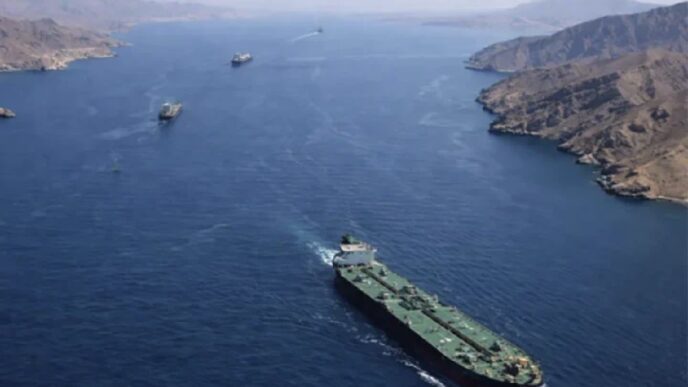
Attention has now shifted to the Strait of Hormuz, a vital shipping route through which about 20 per cent of the world’s oil supply passes. Iran had effectively shut the waterway following the outbreak of hostilities involving the United States and Israel on February 28.
Pakistan’s Prime Minister, Shehbaz Sharif, whose government helped broker the agreement, announced that the reopening process would begin immediately.
“As a first step, the Islamic Republic of Iran will instantly reopen the Strait of Hormuz and the United States of America will immediately lift the naval blockade,” Sharif wrote on X.
Under the deal, Washington will waive oil-related sanctions and facilitate a $300 billion reconstruction fund for Iran, while Tehran has agreed to dilute its enriched uranium stockpile as negotiations continue toward a broader long-term agreement.
The development triggered a sharp decline in crude prices, with both major oil benchmarks falling more than three per cent on Thursday. Oil prices have now dropped by over 15 per cent since reports of a possible agreement first emerged last week.
Stephen Innes of SPI Asset Management said the agreement had significantly reduced geopolitical risks that had driven oil prices higher.
“A signed MOU and a faster path toward reopening the Strait of Hormuz should pull some of the panic premium out of crude,” he said.
“That matters because oil was not just trading war risk. It was trading the possibility that reserve drawdowns and blocked Gulf flows would create an energy cliff.”
While energy markets welcomed the easing tensions, global equities delivered mixed performances as investors assessed the implications of the US Federal Reserve’s latest policy decision.
South Korea’s benchmark Kospi index led gains, surging more than two per cent to cross the 9,000-point mark for the first time, driven by strong demand for artificial intelligence-related semiconductor stocks.
“South Korea supplies around 80 per cent of the world’s memory chips, and artificial intelligence is expected to continue growing for at least another decade,” said Kim Dae-jong, a professor at Sejong University.
“Semiconductors account for roughly half of South Korea’s industrial output, and this is seen as the biggest reason why Kospi broke through the 9,000-point mark.”
Tokyo’s Nikkei index also reached a record high, closing above 71,000 points for the first time. Markets in Singapore, Taipei, Mumbai and Manila recorded gains, while Hong Kong, Shanghai, Sydney, Wellington, Bangkok and Jakarta ended lower.
Meanwhile, the US Federal Reserve left interest rates unchanged but signalled the possibility of tightening monetary policy within the next six months.
The meeting was the first chaired by Kevin Warsh, who stressed the central bank’s commitment to tackling inflation.
“Persistently high prices are a burden for the American people, but the recent past need not be prologue,” Warsh said.
Analysts noted that the Fed’s latest statement placed greater emphasis on inflation than employment, reflecting concerns over rising prices despite a resilient labour market.
By 0810 GMT, West Texas Intermediate crude was down 2.4 per cent at $74.98 per barrel, while Brent crude fell 2.2 per cent to $77.83 per barrel.