

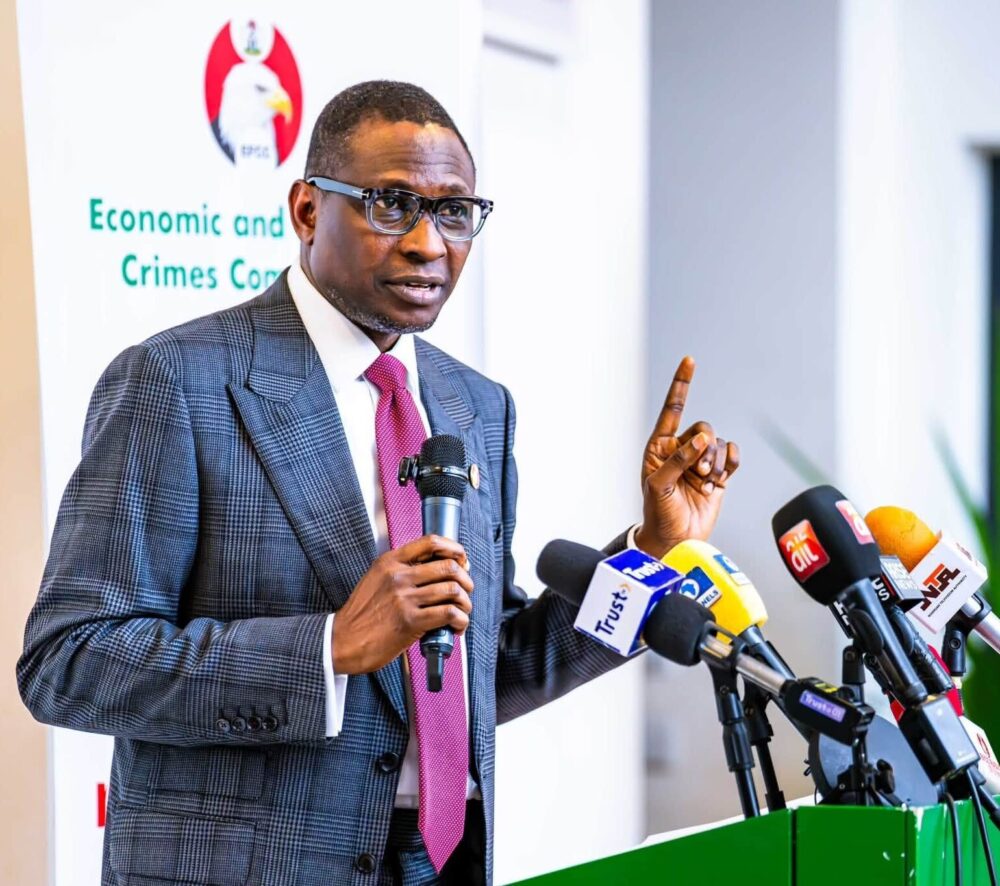
The Chairman of the Economic and Financial Crimes Commission (EFCC), Ola Olukoyede, has urged religious leaders across Nigeria to intensify their preaching against corruption and financial crimes.
Gatekeepers News reports that Olukoyede made the call on Wednesday in Abuja at the 2026 second council meeting of the Nigeria Inter-Religious Council (NIREC), where an anti-corruption interfaith manual for religious leaders was also launched.
Speaking on the theme, “Shared Sacred Flourishing in Nigeria,” the EFCC chairman said the fight against corruption required collective action, stressing that the wellbeing of Nigerians was influenced by the conduct and choices of individuals.
He said corruption undermined shared prosperity by creating divisions and enabling individuals to benefit at the expense of the wider society.
“Corruption privatises what is shared, converts the commonwealth into private advantage, and allows one person to flourish by making many others poorer,” Olukoyede said.
“The unique role of the EFCC, therefore, is to defend the integrity of that commonwealth.”
Olukoyede said religious leaders had a significant role to play in restoring what he described as the “moral dignity of honest living” in society.
He noted that Christianity and Islam could maintain their distinct beliefs and traditions while encouraging their followers to work together for peace, justice, human dignity and the wellbeing of Nigeria.
According to him, the EFCC has over the years engaged religious leaders through an interfaith framework to promote anti-corruption messages in churches and mosques.
“We have been doing this through the interfaith framework. Over the years, we have specifically spelt out what should be the roles of religious leaders and the doctrine they need to pass down to their followers,” he said.
“We believe that no religion condones corruption and no faith entertains fraudulent engagements.”
The EFCC chairman said the commission collaborated with Christian and Muslim leaders to develop the anti-corruption interfaith manual, which contains doctrinal positions from the holy books on corruption.
“We are using this opportunity to launch the manual which we hope our religious leaders will surely find useful in preaching anti-corruption messages to their members,” he added.
Olukoyede stressed that financial crimes affect Nigerians irrespective of their religion or ethnic background.
He said stolen public funds affect both Christians and Muslims, while challenges such as poor infrastructure, unemployment and inflation do not discriminate based on religious affiliation.
He therefore urged pastors and imams to use the newly launched manual to educate their followers on the consequences and dangers of corruption.
“Financial crime has no religion. Corruption has no tribe. Fraud does not become Christian or Muslim because of the identity of the person accused of committing it,” Olukoyede said.
The EFCC chairman also called on religious institutions to take a more active role in preventing corruption, noting that they could help shape the character and values of their followers.
“The EFCC can investigate a person’s conduct. Faith communities can influence that person’s character. We can prosecute fraud. Religious teaching can cultivate honesty,” he said.
“We can confiscate illicit wealth. Churches and mosques can challenge the values that make society worship wealth without questioning its source. We can punish corruption after the event. Faith can help prevent it before it begins.”