



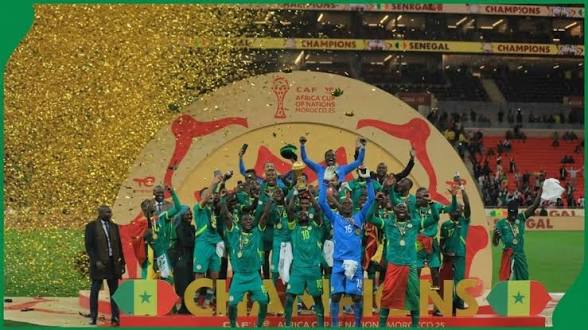
The Court of Arbitration for Sport (CAS) on Thursday began hearing Senegal’s appeal against the decision to strip the country of its Africa Cup of Nations (AFCON) title and award it to Morocco.
Gatekeepers News reports that the hearing, which is taking place in Lausanne, Switzerland, comes nearly 10 months after Pape Gueye scored the decisive goal in extra time to secure Senegal’s victory over tournament hosts Morocco following a chaotic end to regulation time.
Several Senegalese players had walked off the pitch in protest after a late penalty was awarded to Morocco. The match resumed almost 20 minutes later, and Morocco’s Brahim Diaz missed the spot kick.
However, in March, the Confederation of African Football (CAF) overturned the result, awarding Morocco a 3-0 victory and the title.
Thursday’s opening session lasted more than five hours behind closed doors.
“I know that the wait for supporters, as much the Senegalese and Moroccan ones as all African fans, has been very long,” CAS general manager Matthieu Reeb told reporters.
He added that the hearing could continue for “days or even weeks”.
Members of the Moroccan delegation declined to speak to reporters, while Abdoulaye Sow, president of Senegal’s football federation, expressed hope that the case would be decided in accordance with established sporting regulations.
He said he hoped that “sports law” would be upheld “for the dignity and honour of Africa”.
Following Senegal’s victory, Morocco appealed to CAF, which ruled that the Senegalese team had breached regulations prohibiting players from leaving the field without the referee’s authorisation.
Senegal strongly condemned the decision, describing it as the “most blatant administrative robbery in the history of our sport”.
The country’s players also paraded the trophy before supporters in Paris at the end of March, despite CAF’s decision to award the title to Morocco.
Referee’s decision at centre of dispute
Thibault Ulrich, a sports law researcher at the University of Lausanne, described CAF’s ruling as “extremely strict”, arguing that it failed to adequately consider referee Jean-Jacques Ndala’s decision to allow the match to continue.
The International Football Association Board (IFAB), which oversees the Laws of the Game, has provisions suggesting that a referee’s decision to continue a match cannot be overturned simply because it may have been erroneous.
CAS rules also generally favour respecting referees’ decisions unless there is evidence of corruption or bad faith.
These principles could become central to the proceedings as the arbitration panel examines whether CAF was justified in overturning the original result.
The dispute has also raised questions about the integrity of CAF’s decision-making process.
On March 18, the Senegalese government called for an investigation into suspected corruption within the continental football governing body.
The call came after CAF dismissed Yassin Osman Robleh, a lawyer from Djibouti who had overseen the integrity of its procedures for six years. The dismissal occurred about two weeks before CAF ruled in Morocco’s favour, but the organisation did not publicly explain its reasons.
The CAS proceedings are expected to determine whether CAF’s decision to award Morocco a 3-0 victory and the AFCON title should stand or be overturned.