

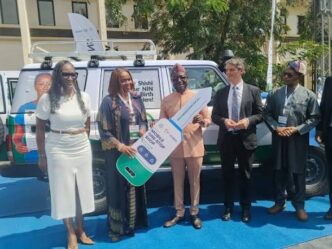
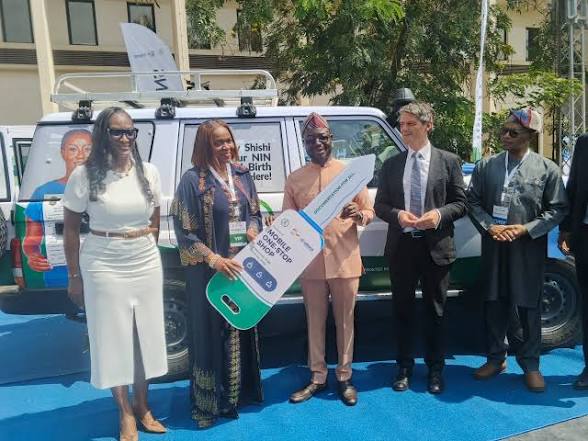
The Federal Government, in partnership with the United Nations High Commissioner for Refugees (UNHCR) and the German government, has deployed 10 mobile documentation centres to provide identification, banking and social protection services to internally displaced persons (IDPs) and other vulnerable Nigerians.
Gatekeepers News reports that the initiative, tagged “One Motor, Plenty Services”, seeks to address challenges faced by displaced persons and underserved communities in accessing essential documents such as National Identification Numbers (NIN), birth certificates and Bank Verification Numbers (BVN).
The specially equipped vehicles have been handed over to 10 state governments to take registration and other government services directly to remote communities.
The beneficiary states are Adamawa, Akwa Ibom, Benue, Borno, Cross River, Katsina, Sokoto, Taraba, Yobe and Zamfara.
Speaking at the handover ceremony in Abuja on Wednesday, the Minister of Humanitarian Affairs and Poverty Reduction, Bernard Doro, said the initiative would help millions of vulnerable Nigerians who struggle to access government services because of distance, displacement and lack of identification documents.
“For millions of our citizens, the problem is not merely that services do not exist. The problem is that those services most often do not reach them,” he said.
Doro explained that the mobile centres would bring multiple services together in one location, eliminating the need for beneficiaries to travel to different government offices to obtain essential documents.
He described identity documentation as a critical component of poverty reduction, noting that people without recognised identification often face exclusion from economic opportunities, government assistance and social protection programmes.
“This matters because ID is the first step out of poverty. You cannot be paid if you cannot be identified. You cannot be protected if you cannot be counted,” the minister said.
“Every NIN issued, and every account opened from these vehicles is a person moving from the margins into the system.”
The minister expressed optimism that the initiative could eventually be expanded beyond the 10 beneficiary states to cover all 36 states and the Federal Capital Territory.
Also speaking, Germany’s Ambassador to Nigeria and ECOWAS, Stefan Brossel, described the vehicles as mobile representations of government designed to bridge the gap between vulnerable citizens and essential public services.
He said the absence of accessible government offices in remote communities had left many Nigerians without vital documents, limiting their access to education, social assistance, telecommunications and financial services.
Brossel urged the beneficiary states to ensure the vehicles remained operational and were deployed to communities where they could deliver the greatest impact.
“A year from now, I will be glad to meet again, not to count vehicles, but people: children with birth certificates, families in the social register, traders with their first bank account,” he said.
Nigeria has 3.7 million displaced persons — UNHCR
The UNHCR Representative in Nigeria, Arjun Jain, said the intervention was particularly important given the scale of displacement in the country and the difficulties government officials face in reaching vulnerable populations.
Jain explained that officials had previously relied largely on their personal vehicles to access remote communities, often without the necessary equipment to provide documentation services to displaced families.
“Today, 3.7 million people are displaced inside Nigeria. If nothing changes, today’s internally displaced become tomorrow’s refugees,” he said.
He disclosed that each mobile centre was equipped with solar power systems, laptops, printers and other technological facilities needed for biometric registration and documentation.
According to him, the equipment would enable officials to provide services in communities where conventional infrastructure and electricity supply remain inadequate.
Meanwhile, the UN Resident and Humanitarian Coordinator in Nigeria and International Labour Organisation Country Director for Nigeria and ECOWAS, Vanessa Phala, described the initiative as an investment in human dignity, inclusion and equal opportunities.
She said access to essential identification documents and financial services could significantly improve the prospects of children, young people and vulnerable families.
“For a child, a birth certificate is a key to opportunity. For a young person, a national identity number can open doors to education and employment. And for a family, access to financial services can provide a pathway to economic independence and livelihood,” she said.