President Bola Ahmed Tinubu says the progress made on the Presidential Power Initiative (PPI) implemented in partnership with Siemens Energy is commendable but still falls short of expectations.
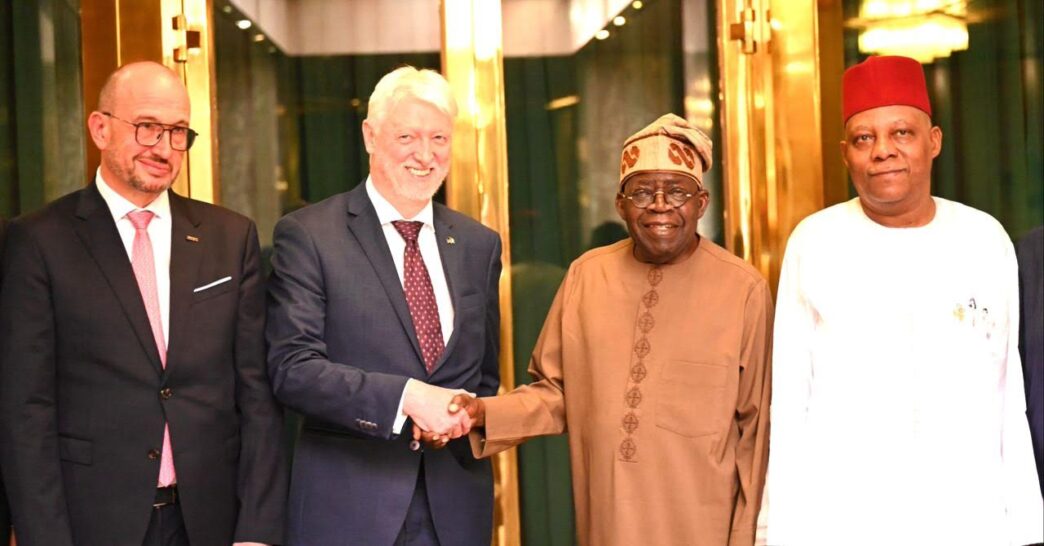
Gatekeepers News reports that Tinubu spoke on Monday during a meeting at the State House, Abuja, with a delegation from Siemens Energy, led by Dietmar Siersdorfer, Managing Director for the Middle East and Africa.
“I appreciate the partnership on the initiative. The progress of the project to date is notable, and we can feel it. But it is not where we want it to be,” Tinubu said.
The president reaffirmed his administration’s commitment to enhancing Nigeria’s electricity supply, describing the power sector as central to economic transformation, industrialisation, and improved livelihoods.
“There is no industrial growth or economic development without power. I believe that power is the most significant discovery of humanity in the last 1,000 years,” he said.
“Our education, our health care, and our transportation all depend on energy — and without power, it is an impossible objective. We are taking it very seriously.”
Tinubu also acknowledged the support of the German government and Siemens Energy, saying their investment aligns with Nigeria’s long-term vision for sustainable growth.
Tinubu Orders Expansion of Transformer Substations
The president directed the expansion of major transformer substations from two to three phases to boost national electricity capacity and accelerate power delivery.
“We are all inspired and happy. This is what we want to achieve on the continent. We want everyone to see the glory of our economic recovery and banishment of poverty,” he said, assuring that the government will continue to provide the resources needed for the project.
Adelabu: PPI Has Attracted Over $2 Billion in Investments
The Minister of Power, Adebayo Adelabu, said the signing of the Electricity Act 2023 and the adoption of a National Integrated Electricity Policy have attracted more than $2 billion in new investments and led to the activation of 15 state electricity markets.
Adelabu explained that since the Accelerated Agreement signed at COP28 in Dubai in 2023, the PPI has recorded key milestones across its phases.
“Under the Pilot Phase (Phase Zero), we have achieved significant infrastructure upgrades and capacity enhancements that are already impacting grid stability and reliability across the country,” he said.
According to him, Siemens has delivered and commissioned 10 units of 132/33kV mobile substations, three units of 75/100MVA transformers, and seven units of 60/66MVA transformers — adding 984MW of transmission capacity to the national grid.
He added that in December 2024, the Federal Executive Council (FEC) approved the engineering, procurement, and construction (EPC) contract for Phase One, Batch One, which includes upgrades and installations at substations in Abeokuta, Offa, Ayede-Ibadan, Sokoto, and Onitsha.
“Plans for civil works mobilisation across all five locations have been finalised, concurrent manufacturing is ongoing, and two of the five substations are targeted for completion by the end of 2026,” Adelabu noted.
He added that Phase One – Batch Two will cover the construction of 16 substations (six brownfield and ten greenfield) with a combined impact of 4,104MW.
Siemens: Training Centre to Build Local Talent
In his remarks, Siersdorfer said two of the five substations are expected to be completed by December 2026, and a training centre is being developed to train local electrical engineers, enhance job creation, and promote technology transfer.
“The PPI is not just a project but a platform for long-term development and prosperity,” he said.
“Nigerian professionals will be directly engaged in the five project sites, while thousands of jobs will be created in local communities through purchased services, accommodation, and transportation.”
Tinubu also pledged to mobilise resources for 10 new mobile power stations across the country, reiterating his determination to make electricity a cornerstone of Nigeria’s economic renewal.