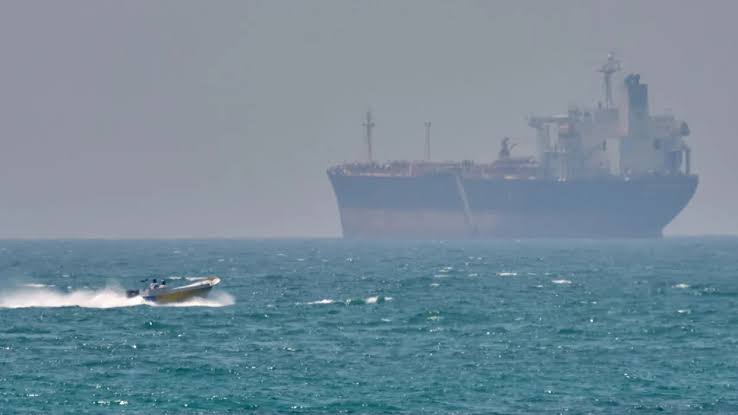
At least two container ships came under attack in the Strait of Hormuz on Wednesday, according to maritime agencies, raising fresh concerns despite US President Donald Trump’s decision to extend a ceasefire aimed at allowing more time for peace negotiations with Iran.
Gatekeepers News reports that the UK Maritime Trade Operations (UKMTO) reported that a container vessel was fired upon by a boat linked to Iran’s Revolutionary Guards (IRGC) about 15 nautical miles northeast of Oman, near the entrance to the strategic waterway. The attack damaged the ship’s bridge but caused no casualties.
Iranian news agency Tasnim claimed the vessel had “ignored warnings from Iran’s armed forces,” which are enforcing a blockade in the area. However, British security firm Vanguard Tech countered that the Liberian-flagged ship had been cleared to pass through the Strait of Hormuz.
In a separate incident, UKMTO said another container ship was targeted and forced to halt about eight nautical miles west of Iran’s coastline. Vanguard identified the vessel as the Panama-flagged containership Euphoria, noting it was “transiting outbound of the Strait of Hormuz.”
The attacks come amid heightened tensions over control of the vital shipping lane, which handles roughly a fifth of global oil and gas exports. While the US Navy has been working to block vessels heading to and from Iranian ports, Tehran insists ships must obtain permission before entering or leaving the Gulf.
The US Defense Department disclosed that its forces had recently intercepted and boarded a “stateless sanctioned” vessel linked to Iranian activity. Both Washington and Tehran continue to accuse each other of violating the ceasefire terms.
Earlier, Trump announced he would extend the two-week truce following a request from Pakistani mediators, saying the move would give Iran’s “fractured” leadership more time to present a proposal.
Although the ceasefire has provided limited relief after weeks of conflict, uncertainty persists. Trump confirmed that the US blockade of Iranian ports would remain in place as diplomatic efforts continue.
On the ground in Iran, residents say the truce has done little to ease hardship.
“This cursed ceasefire has broken us,” said Saghar, 39. “I don’t know anyone around me who is doing well.”
Global markets reacted cautiously, with oil prices and stocks falling on Wednesday as investors weighed the prospects of renewed US-Iran negotiations.
Meanwhile, diplomatic efforts continue on multiple fronts. The UK defence ministry is hosting two days of talks with France involving over 30 countries to address security in the Strait of Hormuz. However, the future of Pakistan-led negotiations remains uncertain after previous talks collapsed over disagreements on Iran’s nuclear programme and control of the waterway.
A White House official confirmed that Vice President JD Vance will not attend the next round of talks in Pakistan until Iran submits a formal proposal. Tehran has yet to confirm whether it will participate, a stance analysts say may be intended to increase pressure on Washington.
Pakistani Prime Minister Shehbaz Sharif and UN Secretary-General Antonio Guterres have both welcomed the extension of the ceasefire.
Elsewhere in the region, violence persists. In Lebanon, one person was killed and two others injured in an Israeli strike on Wednesday, according to state media. The incident comes amid a separate 10-day ceasefire between Israel and Hezbollah.
Hezbollah said it launched rockets and drones at northern Israel in response to what it described as “blatant” ceasefire violations, including “attacks on civilians and the destruction of their homes and villages.” The Israeli military confirmed retaliatory strikes after rockets were fired at its forces in southern Lebanon.
Israel and Lebanon are expected to hold further talks in Washington on Thursday. According to Lebanese authorities, Israeli strikes have killed at least 2,454 people since the conflict began.