

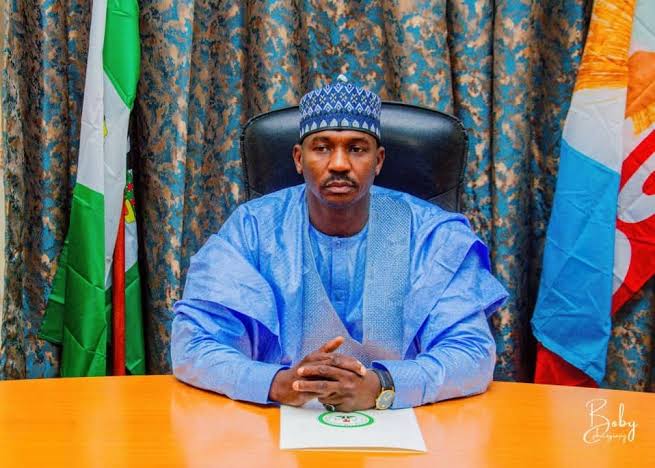
“Every seedling we plant today is a promise to tomorrow—a promise to protect our environment, preserve our land and secure a better future for generations yet unborn.” Governor Ahmed Aliyu
Sokoto State is on the frontline of one of the most persistent environmental threats facing northern Nigeria: desertification. The state’s steady loss of vegetation, the indiscriminate felling of trees and land degradation have placed increasing pressure on arable farmland and water resources for both livestock and man. Climate change and the erratic rainfall have further compounded the problem, making environmental protection not merely an ecological concern, but also an economic and social one. For a predominantly agrarian population, the consequences are serious: as productive land gets degraded and vegetation disappears, food security, household incomes and the livelihoods of rural communities would continue to come under increasing threat. It is against this backdrop that Sokoto State government’s environmental interventions are critical.
For Sokoto State, desert encroachment, deforestation, erosion, flooding, the refusal of residents to provide drainage, poor waste management and climate variability are real and interconnected challenges that threaten the communities and livelihoods. This explains why the response of the administration has been swift and encompassing, extending beyond tree planting to a broader effort to protect the environment and build resilience against the effects of climate change.
The administration’s environmental response goes far beyond the 500,000 seedlings, which Governor Ahmed Aliyu planted in 2026 at Gidan Man Ada Housing Estate, with the target of planting 500,000 seedlings across the state’s 23 local government areas. The campaign is only one part of a broader environmental agenda that encompasses the protection of existing forests, the fight against indiscriminate tree felling, waste management and recycling, erosion and flood control, drainage rehabilitation, water infrastructure, pollution control and other critical measures designed to help communities adapt to the threat. These interventions reflect a holistic approach to environmental protection—one that recognises that safeguarding the state’s future requires more than planting trees; it requires tackling the interconnected challenges that threaten its land, water, communities and livelihoods.
That does not in any way diminish the significance of the tree-planting campaign, because trees provide a natural defence against desertification, protects the soil, creates shelterbelts, improves the local environment and supports livelihoods. Thankfully, Governor Ahmed Aliyu understands the scale of the problem—and the need for a sustained and coordinated action—to tackle the complex problem, of which the annual tree-planting exercise is just a component.
So, what has the Ahmed Aliyu administration done to address these challenges?
One of the state’s notable anti-desertification interventions is the 40-kilometre shelterbelt in the Wurno Local Government Area, established under the Agro-Climatic Resilience in Semi-Arid Landscapes (ACReSAL) programme. The project reflects the recognition that the fight against desertification cannot depend solely on planting trees; it must also involve creating protective environmental infrastructure capable of defending communities and productive land from the gradual encroachment of the desert.
The shelterbelt was designed to serve as a protective barrier against the harsh effects of wind and desertification, helping to reduce the movement of wind-blown sand and protect farmland, settlements and other vulnerable areas in communities within Wurno Local Government Area. Beyond its immediate protective function, the vegetation belts will help improve soil stability, conserve moisture and create a more favourable environment for agriculture.
It represents precisely the kind of long-term environmental infrastructure that a Sahelian state requires—an intervention designed not simply to respond to the effects of land degradation, but to strengthen the resilience of the communities against them.
Another major component of Sokoto’s environmental response is the fight against erosion and flooding, two problems capable of causing extensive damage to communities, infrastructure and livelihoods. Gully erosion can easily swallow farmland, threaten houses and undermine roads and other public infrastructure, while flooding can devastate communities, disrupt transportation and leave significant economic losses in its wake.
The state’s environmental programme has consequently included gully-erosion control, drainage rehabilitation and earthwork projects at vulnerable locations. The 2025 budget provided for erosion-control interventions in areas including Kaura, Kebbe, Tambuwal, Ruman Soraki and Gwadabawa, as well as counterpart funding for interventions under the Nigeria Erosion and Watershed Management Project (NEWMAP).
Sokoto State has also participated in NEWMAP, with intervention areas including Lugu, Tudun Wada/Mabera, Rafin Duma, Sakkwai, Durbawa and Goronyo. These critical interventions include storm-water management and other measures designed to control runoff and reduce the destructive effects of flooding and erosion.
But the shelterbelt is only one project out of the several interventions in the catchment. The state has also established a 500-hectare forest enrichment plantation in Wurno to improve vegetation cover and reduce sheet and rill erosion threatening the fertile Fadama lands. Beyond Wurno, a 7,000-hectare agroforestry initiative involving Moringa trees has been established across 23 communities, linking environmental restoration with food security.
Governor Aliyu’s overall strategy recognises that degraded land, the disappearing vegetation and depleted water resources are closely connected. That is why the ACReSAL intervention includes plans to restore 19 million cubic metres of water in Lugu Dam and the rehabilitation of 1,300 hectares of irrigable land in Wurno. Taken together, these projects show a strategy that goes beyond the annual planting of trees to addressing the wider ecological systems on which agriculture and the people depend.
This is important because the state’s environmental problems do not exist in isolation. Deforestation will certainly accelerate land degradation and erosion; inadequate drainage will definitely worsen flooding; and climate variability can intensify both. Thus, addressing one without addressing the others would have been a partial solution.
Sokoto State’s environmental investment depends not only on how many trees the government plants, but on how effectively the people themselves protect them and how it also tackles the many other forces degrading the environment.
The fire incident at the 40-kilometre Wurno shelterbelt offers both a warning and a lesson.
The shelterbelt was set on fire by unknown people, prompting Governor Aliyu to direct security agencies to identify and apprehend those responsible for the incident. The incident exposes one of the most difficult dimensions of Sokoto State’s environmental challenge. The government can spend millions of naira in planting trees and establishing critical shelterbelts, but if those investments are subsequently destroyed by fire, indiscriminate logging or other human activities, the environmental battle will certainly be lost.
The Wurno experience therefore gives meaning to Governor Aliyu’s insistence that the 500,000 seedlings recently planted must be nurtured and protected. It also explains the Ministry of Environment’s tough position on deforestation, bush burning and forest encroachment.
Environmental protection, however, is not limited to forests and tree planting. The same pressure on the environment is visible in the way waste is generated, collected and disposed of, the condition of drainage channels, the management of erosion-prone areas and the need to control activities that contribute to pollution. These areas require sustained government attention because poor waste disposal can block drainage and worsen flooding, while uncontrolled environmental degradation can undermine the gains made through tree planting and other restoration projects.
This is why waste management, recycling, drainage rehabilitation and pollution control are important parts of the wider environmental response. They are not separate from the fight against desertification; they form part of the same effort to keep communities safer, protect public infrastructure and ensure that environmental investments deliver lasting benefits.
The responsibility, however, does not rest with government alone. The Wurno experience demonstrates that environmental projects require community ownership and protection. Trees planted by government for the benefit of the people must be protected by the communities where they are located. Bush burning, indiscriminate tree felling, forest encroachment and other activities that undermine the huge environmental investments cannot be addressed by the government alone. They require public awareness, community participation and effective enforcement of environmental regulations.
As Tangaza warned during the 2026 campaign, “We cannot plant trees aggressively while allowing reckless deforestation to undermine our progress.”
It’s gratifying that the Ministry of Environment has expanded the scope of this year’s campaign. According to Nura Shehu Tangaza, commissioner of environment, the state is distributing climate-resilient seedlings, including economic trees and shelterbelt species, to households, schools, religious centres and farm plots.
The planned reconstruction of Lugu Dam, estimated at ₦33 billion, is particularly significant.The project has implications for flood management, irrigation and dry-season agriculture, making it part of a broader effort to strengthen resilience in communities vulnerable to environmental and climatic pressures.
This demonstrates why environmental policy of Governor Aliyu cannot be divorced from agriculture and water security. A community that has access to reliable water, irrigation and appropriate environmental infrastructure is better positioned to withstand the effects of climate variability.
Governor Aliyu has repeatedly linked Sokoto’s environmental vulnerability to its location in the Sahel. At the 2026 tree-planting campaign, he warned that desert encroachment was advancing at an alarming rate and called for collective action.
The use of climate-resilient seedlings and shelterbelt species in the 2026 programme reflects an attempt to make tree planting more suited to the state’s harsh environmental conditions.
For Governor Aliyu, the state does not merely need to plant trees. It needs to ensure that those trees become part of a permanent environmental defence against the desert.
That is why the environmental story of the Aliyu administration is bigger than an annual tree-planting ceremony.