


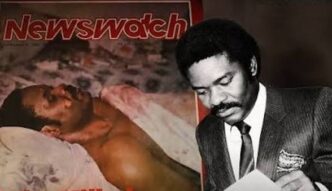
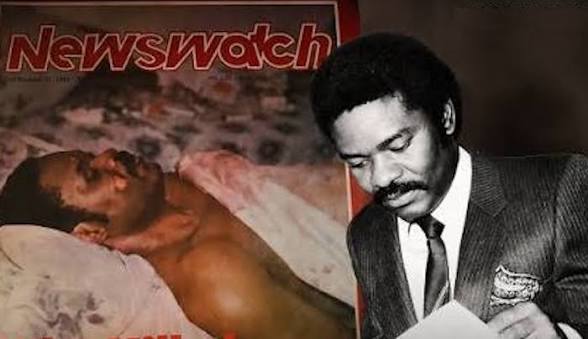
Dokun Adedeji, a medical doctor who treated Dele Giwa after a parcel bomb explosion, has recounted the late journalist’s final moments and his desperate question about whether he would survive the attack.
Gatekeepers News reports that Adedeji spoke on Monday at the launch of Dele Giwa’s Granite Journalism at the Nigerian Institute of Journalism (NIJ) in Lagos. The book chronicles some of the writings of the founding editor-in-chief of Newswatch Magazine for Daily Times, Sunday Concord and Newswatch.
Giwa was killed on October 19, 1986, when a parcel bomb delivered to his residence in Ikeja, Lagos, exploded. His assassination occurred during the military administration of Ibrahim Badamasi Babangida, who ruled Nigeria from 1985 to 1993.
‘It was better that he died’
Speaking at the event organised by Newswatch alumni in honour of the late journalist, Adedeji described the severity of Giwa’s injuries and recalled the words he uttered while receiving emergency treatment.
Adedeji said he was the doctor on duty when Giwa was rushed to First Foundation Medical Centre in Opebi, Ikeja, shortly after the explosion.
“It was about 12:30 in the afternoon when a company bus was driven into First Foundation Medical Centre Opebi, Ikeja,” he said.
“I was the doctor on duty for the weekend. I saw people running, saying, ‘they brought Dele Giwa’.”
He said Giwa was severely injured and bleeding profusely but remained conscious and able to speak.
“So, we took Uncle Dele to the emergency room. What I saw, I have never seen again since in my practice. He was shattered. His two limbs were open, and he was bleeding.
“But he was still talking. He said, ‘Dokun, se mi o ni ku sha? (I hope I will not die?)’. I said, ‘I don’t know’.”
Reflecting on the extent of the injuries, Adedeji said Giwa’s chances of survival were extremely slim.
“One thing was sure. I think it was better that he died. There was no way Uncle Dele would have lived with that injury even if he lived,” he said.
Adedeji said Giwa died at about 1 p.m., adding that the experience remained deeply etched in his memory.
“He died around 1pm. His blood was on my clothes and my shoes. I hung them for five years in the corner of my room, so that every time I saw them, I would remember.
“Uncle Dele was not just my patient. He was like a brother. He treated me like a brother.”
The doctor also recalled that Giwa repeatedly asked about his wife, Funmi, and his youngest daughter, Aisha, who had crawled into the dining area after the bomb exploded.
“How is Aisha? Do you know anything about Aisha?” Giwa asked at the hospital, according to Adedeji.
The days before Giwa’s assassination
Giwa, who was 39 when he died, was widely regarded as a fearless investigative journalist whose reporting scrutinised those in power and examined the inner workings of government.
His assassination came two days after he was questioned by officials of the State Security Service (SSS).
The Newswatch editor had written an article on the Second-Tier Foreign Exchange Market (SFEM), a Central Bank of Nigeria policy introduced at the time to determine the naira exchange rate and allocate foreign exchange according to market forces.
In the article, Giwa warned that if the policy failed, Nigerians would stone “their leaders in the streets”.
Around the same period, Giwa was questioned by Halilu Akilu of the then-Directorate of Military Intelligence (DMI) over allegations that he had been heard discussing arms importation with some people.
He appeared at the SSS headquarters on October 16, 1986, three days before his death.
On October 18, Akilu reportedly called Giwa’s residence and asked his wife, Funmi, for directions, saying he intended to visit on his way to Kano.
On the day of the assassination, the DMI official reportedly told Giwa over the telephone that the matter had been resolved after the journalist questioned his repeated calls.
Shortly after the conversation, a package was delivered to Giwa’s residence. The parcel bomb exploded, leaving him critically injured.
Kayode Soyinka, Newswatch’s London bureau chief, was with Giwa at the time but narrowly escaped the blast after excusing himself to visit the restroom.
Giwa was taken to hospital but later died from his injuries.
The journalist would have turned 79 in 2026.


